The Men Who Couldn't Go Home
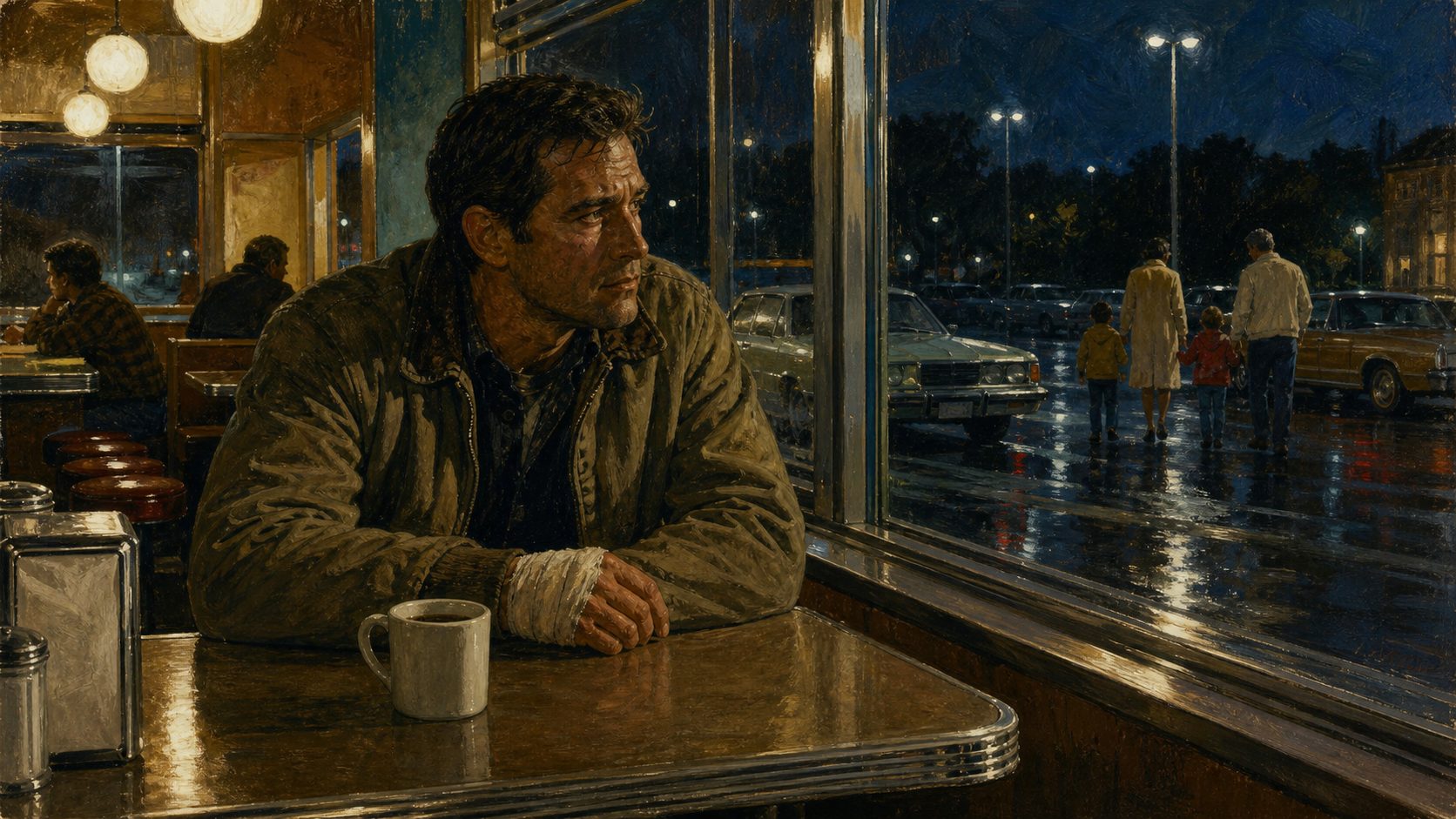
The mission ends. The rescued go back to their families. The hero is gone before breakfast.
You see that pattern so often in these books it can look like plain series maintenance. A hero who settles down is hard to ship off into danger every month, and the checks depend on the danger. But something heavier is going on under the convenience. The hero guards a kind of life he won't let himself have.
Call it a power fantasy if you want. Underneath, it's a story about exile.
The wandering inheritance
The paperback warrior comes down from Western gunfighters and the wandering knights before them. He rides into a troubled town because he can face the thing nobody else there can face. Then he fixes it, and the same strangeness that let him fix it leaves him with no place at the table.
Home means safety, routine, people who count on you, a future measured in years instead of missions. Good things, all of them. They also cost you something: you have to be able to get hurt. A man who stays has to let people learn where he sleeps, what scares him, how much their loss would gut him.
His enemies make that kind of attachment dangerous. His own habits make it close to impossible.
So he dresses the loneliness up as sacrifice. Leaving keeps other people safe, he tells himself, and a lot of the time he's right. It also spares him the far harder job of staying.
Brotherhood without confession
Men's adventure is full of feeling that never says its own name. Men clean each other's wounds. They stand watch. They go back into the fire for a partner, split the last of the food, refuse to leave a body behind. The act is the declaration of love, because nobody's going to say the words.
That can hit hard, and it's not nothing. It honors the kind of care that shows up as reliability instead of speech. Plenty of readers grew up around fathers and friends who'd drive all night to help you and still couldn't manage "I was scared for you." The books knew that a quiet man isn't always an empty one.
Only silence has a ceiling. If every feeling has to turn into a deed, grief has just one exit, and it's revenge. Fear turns into aggression. Need turns into a mission. And the hero forgets how to take care when it's offered, because taking it would mean admitting he wanted it.
I'd rather read the version where the deeds and the words stay in the room together, neither one let off the hook by the other.
Women and the temporary refuge
Romance hands the hero a short lease on a home. Some woman sees past the professional to the man, and for a few chapters he lets himself picture a different life. Then she's in danger, or dead, or a plant working the other side, or shipped off somewhere safe for her own good. Reset.
Commercially, tidy. Emotionally, it just confirms the thing he was already afraid of: get close to me and you end up a casualty.
Run that often enough and it turns into cruel machinery. The woman is there to prove the hero can love and that loving him is fatal. Her death makes him deeper and makes her gone.
The better version lets her have a mind of her own. Maybe she turns down the life he's offering. Maybe she turns down the life he refuses to offer. Maybe the real problem was never the goons at the door but a man who can't stop filing intimacy under operational risk.
The hero after midnight
The moments that give him away are the ones where nobody needs rescuing. He's in a motel with bad coffee, phoning no one, watching somebody else's family through a window. Those dead hours explain all the noise around them. He keeps moving because moving is who he is, and because stopping means finally settling accounts with himself.
I wouldn't read the loneliness as a bid for pity. He may have picked it with his eyes wide open. A sacrifice can be genuinely noble and also weirdly convenient for the man making it, and both things can sit there at once. That's the interesting part.
Readers didn't love these men only for the power. They loved them because the power hadn't bought them any safety. A guy could own the whole battlefield and still come apart at a memory, a soft word, or a simple "So where do you live?"
The home he carries
Some of the long series eventually hand the warrior a stand-in family. A team, a handler, a base, a mentor, a regular crew of allies. That patches up part of the ache. He belongs somewhere now. Trouble is, the belonging is built around the job.
Progress and dodge, same move. Sure, the team shares the risk and the history. But if the only closeness on offer is mission closeness, then the war still gets to draw the borders of his life.
The bravest ending for a man like this probably isn't dying in a firefight. It's staying put after the shooting stops. Learning to live somewhere he's useful but not the only one holding the roof up.
The books almost never let him get there. They end on one more road, one more enemy, one more night by himself.
We remember the warrior walking off into the dark because some part of us respects the sacrifice.
Another part of us wishes to God somebody had taught him how to come home.
Next in the series → ← Back to The Pulp Desk