What Noir Means
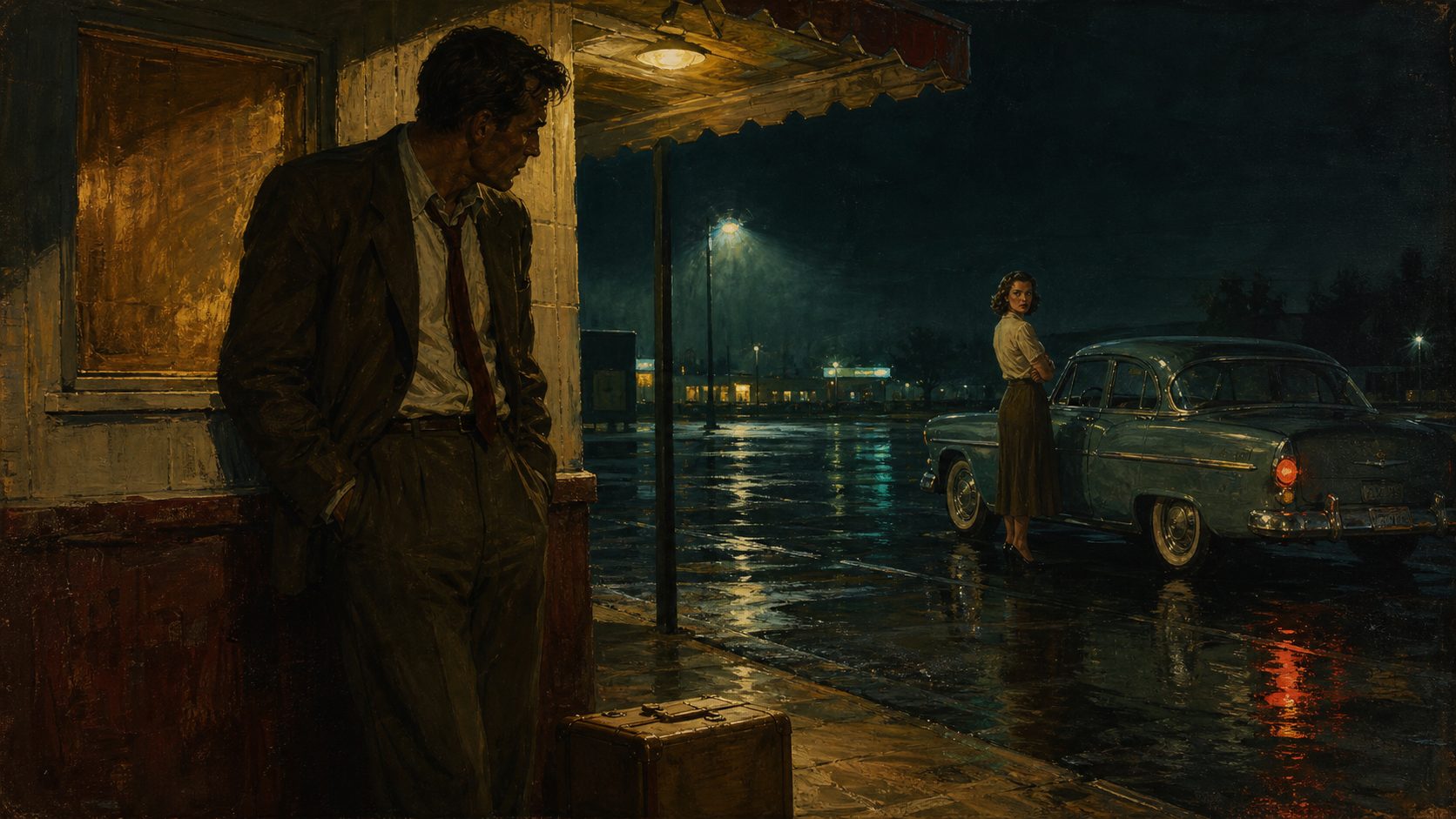
By now "noir" is a mood you can buy off a shelf. Streak some rain down a window, kill the lights, stand a tired man in a trench coat, and the word shows up before anybody's done a single thing wrong. The old paperback writers are useful precisely because they'd tell you that's backwards. Noir was never a lighting scheme. It was a way of building a moral trap and watching a man walk into it.
Hard-boiled is not automatically noir
Hard-boiled is a matter of method and voice: flat direct prose, no sentiment in the observing, a professional who's good at his job, violence treated as ordinary weather. A hard-boiled detective can wade straight into the corruption, take his beating, and come back out with his soul more or less where he left it.
Noir tends to drop the man inside the corruption instead, with no clean way back. He's already in it, hooked by what he wanted or what he chose or the lie he told himself to keep going. The plot doesn't just come after him from outside. It grows out of his own appetite. The line between the two isn't a wall, and I wouldn't pretend it is, but it's worth keeping. A trench coat doesn't make noir. A lie a man prefers to the truth just might.
Doom is not enough
A grim ending can be nothing but a coin flip the author called tails. Real noir only feels inevitable once you're looking back at it. The man had exits, every one of them open, and every one of them cost something he'd decided to value over his own safety: his pride, or the fantasy, or the money, or the thing he had to have, or the flattering picture of himself he couldn't stand to smudge.
You hold two facts at once and they don't cancel out. He could have chosen differently. Given who he'd already decided to be, he was never going to. That's a design, built on purpose, not a gray cloud the writer rolled in over the last chapter for the mood of it.
What the paperback field knew
These writers had it figured out between them, book by cheap book. Charles Williams knew that being good at your job won't save you once the whole setup is rotten with what you want. With Peter Rabe, the point is that understanding exactly how power works doesn't make your own use of it any cleaner. Gil Brewer's whole fever is a feeling turned up loud enough to pass itself off as the truth. Harry Whittington knew that people tighten a trap far better than any piece of machinery. And Vin Packer's territory is a respectable society that can manufacture a secret and then punish the person for keeping it.
Put them together and you get a picture of an America where the private mess and the public pressure just won't come apart at the seam. The books don't let the individual off by blaming society, and they don't let society off either. What they show is people picking up society's own values (win, own things, look like a success) and running them straight off a cliff into a crime.
The limitations remain
Plenty of paperback noir shrank women down to whatever shape male nerves found most exciting. It could treat a Black or brown face as scenery, or as the thing in the shadows. Queer life mostly got in through the side door of censorship and got punished on the way out. A bystander could die and count for less than the hero's bruised ego.
Say all of that out loud when you go back to these books. Finding a lost thing doesn't scrub it clean. And you can hold both hands at once. You can see clearly how narrow a book is and still bow to the way it's put together, the way it compresses a whole ruined life into forty thousand words, a single sentence that knows exactly what desperation sounds like at two in the morning.
The paperback afterlife
Modern crime fiction, film, and television are still running the old paperback-original engine. An ordinary person wants out, takes the compromise, and starts improvising as the consequences pile up faster than he can duck. The reprint lines have done real good, dragging neglected books back into print and commissioning new ones dressed in the period's paint and lettering.
The trap is that the paint becomes the whole tribute and the substance quietly leaves the building. Anybody can fake the package: a painted cover, a lurid title, a few tough lines of dialogue. The old books are owed something deeper than a costume. Give the man a desire that exposes the world he lives in. Every exit should cost him the exact thing he claims to love. His competence ought to make the danger worse when he spends it protecting a lie. The women and the outsiders need an inside, not just a role in his fear. And the doom has to be a trail of choices he made, not weather that blew in from offstage.
Beyond the famous names
Hammett, Chandler, and Spillane still matter and always will. But American crime fiction also got written at a dead run by people whose books rode through grocery racks and bus-station spinners, passed through millions of hands, and vanished with nothing and nobody protecting them.
The best of that work never once asked to be called important. It asked to be bought before the customer's bus pulled out. It lasted anyway, and it lasted because the thing underneath it hasn't gone anywhere. Ordinary hunger. The promises this country keeps making. And that exact moment a person decides the rules are the reason he's earned the right to break them. Watch for that moment. Everything the book does afterward is just the bill coming due.
That's the series. Head to the books →
← Back to The Pulp Desk