What the Paperback Warriors Left Behind
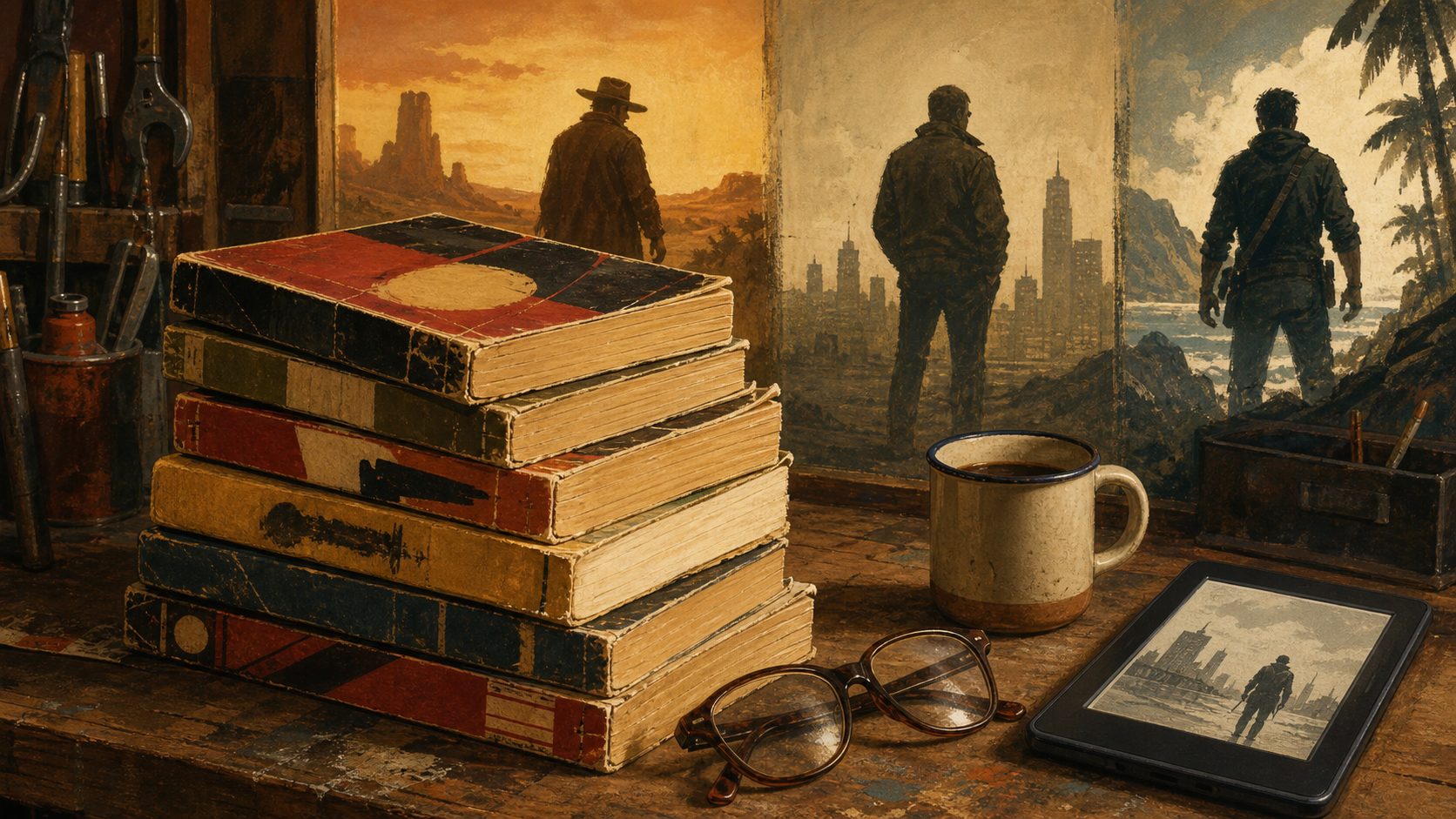
The paper was cheap. What got passed down wasn't.
The men's adventure boom didn't so much end as change shape. It thinned out on the drugstore racks and leaked its instincts into everything else. The lone veteran, the deniable operative, the avenger who won't quit, the survival guy, the man with his own private code: they all walked off the paperback rack and into movies, TV, comics, video games, military thrillers, and the indie novels people self-publish now.
New names, new formats. The promise underneath came through intact.
The descendants
He's all over the modern action hero, the one who owns almost nothing, clocks every exit, and carries some grievance he won't talk about. He's in the mission games built on prep and gear and sneaking in and things blowing up bigger by the level. And he's in every thriller series where the old unit, the dead family, or the broken oath is the reason the hero can't just go home.
Some of them only inherit the outline. You get the coat, the hardware, the clipped dialogue, the competence that never fails. Others get the engine underneath: a hurt person trying to point dangerous skills at something worth pointing them at.
It's the second kind that's worth anything.
What deserves to survive
Start with directness. These books knew how to open and how to keep going. A clear objective, a threat building in the corner, choices you could watch land: they trusted that readers like that, and readers do.
Then there's respect for competence. Skill in these books wasn't fairy dust sprinkled on the hero. At its best it came from preparation and attention and doing the dull work beforehand. The man won because he'd already done the thinking before anyone started shooting.
Moral urgency, too. The genre could be dumb as a bag of rocks, but it never shrugged. Predators were a problem. Betrayal cost something. Weak people deserved somebody in their corner. The comfortable citizen who looked away from evil had, in these books, made a choice, and the book knew it.
And courage without a crowd watching. The paperback warrior usually worked anonymous. He didn't need a medal or a press conference or anybody's thanks to keep a promise.
Last, momentum. A book can be smart and still be fun; those aren't enemies. You can move fast and still carry grief, politics, a few jokes, and a real argument about right and wrong on the same pages.
What should be left behind
Invincibility, first thing. When the hero can't lose, danger stops meaning anything, and everybody standing next to him turns into an audience.
The idea that a tough man has to be a mute one can go too. Being reserved can hit hard on the page. But a guy who literally can't feel anything isn't the only honest way to write a man, and pretending otherwise got old fast.
Women can't keep being prizes, or traps, or a corpse whose only job is to get the hero moving. Other countries can't stay theme-park backdrops for the next firefight. And you can't mow down faceless henchmen by the dozen while the book keeps patting the hero on the back for how much he treasures human life. Readers can count, even when the author's hoping they won't.
The gun-catalog stuff should serve the story instead of auditioning to prove the author did his homework. Making the threat bigger shouldn't stand in for making it closer. And the hero's code should be a leash on him, not a rubber stamp on whatever he already wanted to do.
Dropping all that doesn't make the genre soft. It makes the danger easier to believe and the hero's choices a lot more expensive.
The modern paperback warrior
A worthy version of this guy today doesn't owe anybody an apology for being masculine, physical, or just plain fun to read. He can be a hard man. He can use violence. He can carry the old virtues, loyalty and endurance and owning what he does, without a wink.
He should also live in a world with other capable grown-ups in it, not a landscape of props. He should be able to get it wrong. When he hurts someone it should leave a mark, on the body and on the people around it and on the town he did it in. His code should run into problems it was never built for. And he should know, somewhere, that protecting people you don't respect is just another word for running them.
Most of all, he should want something past surviving into the next book. He might never get home. But we should know what home would be for him, or none of the rest of it means much.
Reading the old books now
Nostalgia has a way of buffing off exactly the thing that made something interesting in the first place. These old paperbacks weren't a shelf of secret masterpieces. Some were quick and clever. Some were clumsy as hell. Some carried assumptions that make you wince now. And some had more real feeling in them than the lurid cover ever let on. Plenty of them managed several of those at once, inside the same hundred and sixty pages.
Pretending otherwise doesn't honor them.
Loving something with your eyes open lasts longer than defending it with them shut. It lets you say a scene still works, a hero still lands, and an old prejudice still drags the book down, all in one breath. You don't have to choose between liking these books and being honest about them.
A lot of people remember exactly where they got these. A spinner rack. The grocery store. An uncle's shelf. A barracks, a bus station, a box for a quarter at a yard sale. They remember the cracked spine and the painted cover and the little number on it promising other adventures before and after this one. The books lived in a physical world, of waiting rooms and lunch breaks and long drives and coat pockets.
Remembering that world isn't only missing being young, though there's some of that in it. It's remembering being talked to straight, as a reader. The book promised something was going to happen. It promised that nerve and preparation would count for something. It promised that one person could refuse to look away.
That's still a promise worth making.
The last word
The paperback warrior was never just the man with the gun. He was a man hauling around a wound, a code, and a job that couldn't be finished. The genre went shallow every time it forgot the wound, or let the code slide into an excuse. It got strong when the action put real pressure on both at once.
We can keep the speed. We can keep the danger and the professionalism, the loyalty, the empty road at night, and the flat refusal to let cruelty go unanswered.
And we can widen the world around him. We can let the consequences stay put after the smoke clears instead of resetting the board. We can give him people who won't reduce to a mission and problems a gun doesn't fix.
Nobody has to call the old books perfect to call them ancestors.
They were loud and fast and printed on paper that's gone brown by now. The best of what they knew hasn't gone anywhere. Somebody's going to pull one out of a box at a yard sale next weekend and find that out for himself.
That's the whole series, all twelve parts. The books are this way →
← Back to The Pulp Desk